 Add to Chrome
 Add to Firefox
 Add to Edge
VESTA: Visual Exploration with Statistical Tool Agents
May 29, 2026
Fitting quantitative models to data is a central step in scientific workflows, yet it remains one of the least automated. Recent agent-based systems leverage language and vision-language models (VLMs) to iteratively propose and refine statistical models, but these systems struggle on more challenging modeling tasks. To address these limitations, we introduce VESTA: Visual Exploration with Statistical Tool Agents, a framework that equips VLMs with a dynamically growing exploration toolkit to guide model refinement through data transformations, hypothesis-driven visualizations, and robust statistical tests. Unlike prior systems that rely on iterative critique alone, VESTA actively explores data before and during refinement by selecting or creating diagnostic tools, which accumulate in the model's context and can be reused later. We evaluate VESTA against established baselines in three toolkit configurations: no tools, static expert-written tools, and dynamic model-written tools. To support this evaluation, we introduce DAWN (Dataset for Automated Workflows and Numerical Modeling), a benchmark targeting distribution fitting and time series modeling with varying difficulty tiers, and culminating in real-world astronomy tasks including modeling initial mass functions and gravitational-wave chirp signals. We find that VESTA's dynamic tool creation outperforms prior agentic pipelines, with the largest gains on complex and domain-specific tasks. We further show that dynamically generated tools are substantially more sophisticated than those produced by existing visual tool-creation systems, covering more diagnostic categories per function and strongly preferring visual outputs that the VLM critic can reason over directly.

The Counterexample Game: Iterated Conceptual Analysis and Repair in Language Models
May 05, 2026Conceptual analysis -- proposing definitions and refining them through counterexamples -- is central to philosophical methodology. We study whether language models can perform this task through iterated analysis and repair chains: one model instance generates counterexamples to a proposed definition, another repairs the definition, and the process repeats. Across 20 concepts and thousands of counterexample-repair cycles, we find that, although many LM-generated counterexamples are judged invalid by both expert humans and an LM judge, the LM judge accepts roughly twice as many as humans do. Nonetheless, per-item validity judgments are moderately consistent across humans and between humans and the LM. We further find that extended iteration produces increasingly verbose definitions without improving accuracy. We also see that some concepts resist stable definitions in general. These findings suggest that while LMs can engage in philosophical reasoning, the counterexample-repair loop hits diminishing returns quickly and could be a fruitful test case for evaluating whether LMs can sustain high-level iterated philosophical reasoning.
Causal Drawbridges: Characterizing Gradient Blocking of Syntactic Islands in Transformer LMs
Apr 15, 2026We show how causal interventions in Transformer models provide insights into English syntax by focusing on a long-standing challenge for syntactic theory: syntactic islands. Extraction from coordinated verb phrases is often degraded, yet acceptability varies gradiently with lexical content (e.g., "I know what he hates art and loves" vs. "I know what he looked down and saw"). We show that modern Transformer language models replicate human judgments across this gradient. Using causal interventions that isolate functionally relevant subspaces in Transformer blocks, attention modules, and MLPs, we demonstrate that extraction from coordination islands engages the same filler-gap mechanisms as canonical wh-dependencies, but that these mechanisms are selectively blocked to varying degrees. By projecting a large corpus of unrelated text onto these causally identified subspaces, we derive a novel linguistic hypothesis: the conjunction "and" is represented differently in extractable versus non-extractable constructions, corresponding to expressions encoding relational dependencies versus purely conjunctive uses. These results illustrate how mechanistic interpretability can inform syntax, generating new hypotheses about linguistic representation and processing.
You Can't Fight in Here! This is BBS!
Apr 10, 2026Norm, the formal theoretical linguist, and Claudette, the computational language scientist, have a lovely time discussing whether modern language models can inform important questions in the language sciences. Just as they are about to part ways until they meet again, 25 of their closest friends show up -- from linguistics, neuroscience, cognitive science, psychology, philosophy, and computer science. We use this discussion to highlight what we see as some common underlying issues: the String Statistics Strawman (the mistaken idea that LMs can't be linguistically competent or interesting because they, like their Markov model predecessors, are statistical models that learn from strings) and the As Good As it Gets Assumption (the idea that LM research as it stands in 2026 is the limit of what it can tell us about linguistics). We clarify the role of LM-based work for scientific insights into human language and advocate for a more expansive research program for the language sciences in the AI age, one that takes on the commentators' concerns in order to produce a better and more robust science of both human language and of LMs.
When to Call an Apple Red: Humans Follow Introspective Rules, VLMs Don't
Apr 07, 2026Understanding when Vision-Language Models (VLMs) will behave unexpectedly, whether models can reliably predict their own behavior, and if models adhere to their introspective reasoning are central challenges for trustworthy deployment. To study this, we introduce the Graded Color Attribution (GCA) dataset, a controlled benchmark designed to elicit decision rules and evaluate participant faithfulness to these rules. GCA consists of line drawings that vary pixel-level color coverage across three conditions: world-knowledge recolorings, counterfactual recolorings, and shapes with no color priors. Using GCA, both VLMs and human participants establish a threshold: the minimum percentage of pixels of a given color an object must have to receive that color label. We then compare these rules with their subsequent color attribution decisions. Our findings reveal that models systematically violate their own introspective rules. For example, GPT-5-mini violates its stated introspection rules in nearly 60\% of cases on objects with strong color priors. Human participants remain faithful to their stated rules, with any apparent violations being explained by a well-documented tendency to overestimate color coverage. In contrast, we find that VLMs are excellent estimators of color coverage, yet blatantly contradict their own reasoning in their final responses. Across all models and strategies for eliciting introspective rules, world-knowledge priors systematically degrade faithfulness in ways that do not mirror human cognition. Our findings challenge the view that VLM reasoning failures are difficulty-driven and suggest that VLM introspective self-knowledge is miscalibrated, with direct implications for high-stakes deployment.
Dissociating Direct Access from Inference in AI Introspection
Mar 05, 2026Introspection is a foundational cognitive ability, but its mechanism is not well understood. Recent work has shown that AI models can introspect. We study their mechanism of introspection, first extensively replicating Lindsey et al. (2025)'s thought injection detection paradigm in large open-source models. We show that these models detect injected representations via two separable mechanisms: (i) probability-matching (inferring from perceived anomaly of the prompt) and (ii) direct access to internal states. The direct access mechanism is content-agnostic: models detect that an anomaly occurred but cannot reliably identify its semantic content. The two model classes we study confabulate injected concepts that are high-frequency and concrete (e.g., "apple'"); for them correct concept guesses typically require significantly more tokens. This content-agnostic introspective mechanism is consistent with leading theories in philosophy and psychology.
From sunblock to softblock: Analyzing the correlates of neology in published writing and on social media
Feb 13, 2026Living languages are shaped by a host of conflicting internal and external evolutionary pressures. While some of these pressures are universal across languages and cultures, others differ depending on the social and conversational context: language use in newspapers is subject to very different constraints than language use on social media. Prior distributional semantic work on English word emergence (neology) identified two factors correlated with creation of new words by analyzing a corpus consisting primarily of historical published texts (Ryskina et al., 2020, arXiv:2001.07740). Extending this methodology to contextual embeddings in addition to static ones and applying it to a new corpus of Twitter posts, we show that the same findings hold for both domains, though the topic popularity growth factor may contribute less to neology on Twitter than in published writing. We hypothesize that this difference can be explained by the two domains favouring different neologism formation mechanisms.
LLMs and people both learn to form conventions -- just not with each other
Feb 09, 2026Humans align to one another in conversation -- adopting shared conventions that ease communication. We test whether LLMs form the same kinds of conventions in a multimodal communication game. Both humans and LLMs display evidence of convention-formation (increasing the accuracy and consistency of their turns while decreasing their length) when communicating in same-type dyads (humans with humans, AI with AI). However, heterogenous human-AI pairs fail -- suggesting differences in communicative tendencies. In Experiment 2, we ask whether LLMs can be induced to behave more like human conversants, by prompting them to produce superficially humanlike behavior. While the length of their messages matches that of human pairs, accuracy and lexical overlap in human-LLM pairs continues to lag behind that of both human-human and AI-AI pairs. These results suggest that conversational alignment requires more than just the ability to mimic previous interactions, but also shared interpretative biases toward the meanings that are conveyed.
Mechanisms of Prompt-Induced Hallucination in Vision-Language Models
Jan 08, 2026Large vision-language models (VLMs) are highly capable, yet often hallucinate by favoring textual prompts over visual evidence. We study this failure mode in a controlled object-counting setting, where the prompt overstates the number of objects in the image (e.g., asking a model to describe four waterlilies when only three are present). At low object counts, models often correct the overestimation, but as the number of objects increases, they increasingly conform to the prompt regardless of the discrepancy. Through mechanistic analysis of three VLMs, we identify a small set of attention heads whose ablation substantially reduces prompt-induced hallucinations (PIH) by at least 40% without additional training. Across models, PIH-heads mediate prompt copying in model-specific ways. We characterize these differences and show that PIH ablation increases correction toward visual evidence. Our findings offer insights into the internal mechanisms driving prompt-induced hallucinations, revealing model-specific differences in how these behaviors are implemented.
Convergence and Divergence of Language Models under Different Random Seeds
Sep 30, 2025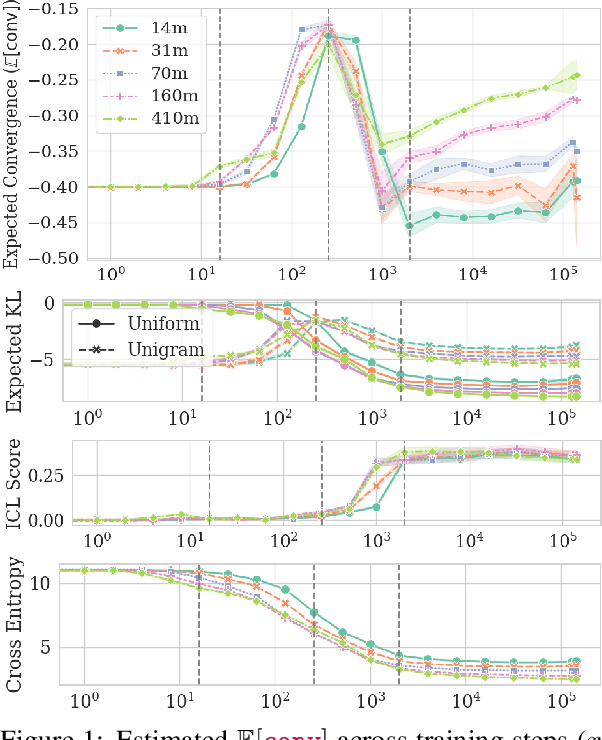
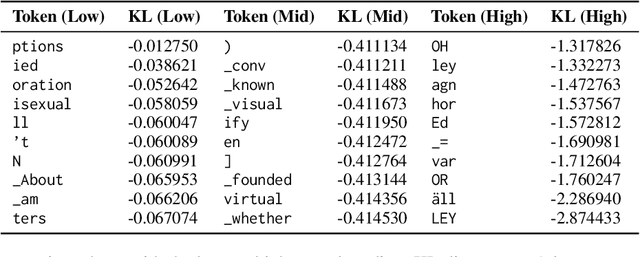
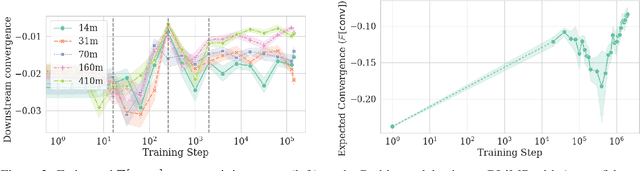
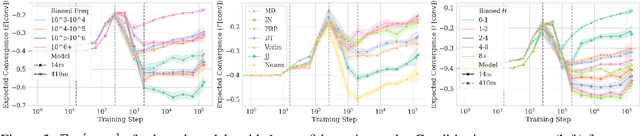
In this paper, we investigate the convergence of language models (LMs) trained under different random seeds, measuring convergence as the expected per-token Kullback--Leibler (KL) divergence across seeds. By comparing LM convergence as a function of model size and training checkpoint, we identify a four-phase convergence pattern: (i) an initial uniform phase, (ii) a sharp-convergence phase, (iii) a sharp-divergence phase, and (iv) a slow-reconvergence phase. Further, we observe that larger models reconverge faster in later training stages, while smaller models never actually reconverge; these results suggest that a certain model size may be necessary to learn stable distributions. Restricting our analysis to specific token frequencies or part-of-speech (PoS) tags further reveals that convergence is uneven across linguistic categories: frequent tokens and function words converge faster and more reliably than their counterparts (infrequent tokens and content words). Overall, our findings highlight factors that influence the stability of the learned distributions in model training.